

 Been there, taken the photographs, got the T-shirt and according to that criterion Peru is a multi T-shirt country.
I promised myself a trip to Peru, specifically Machu Picchu, as a reward if I got re-elected early this year, click here for that story. Well I did so I went.
I joined a Canadian tour and there were 16 of us in total and we did the south part of the country and that merited maybe five T-shirts:
- Machu Picchu itself (be careful to include 2 c’s in Picchu and to pronounce it otherwise it comes out rude in Spanish): it’s as much as it’s cracked up to be and more. As you emerge onto the first viewing platform it seems bigger and more vivid that any photograph.;
- the Nasca lines in the coastal desert: dismissing them as crop circles in the sand is, well, dismissive. You’ve got to get in a plane to appreciate them. And we still don’t know who drew them and why;
- the coastal desert itself: it’s the driest/second driest in the world and yet it runs alongside the sea and it’s at a latitude which elsewhere means tropical and high humidity. Fertile valleys cut through it fed with waters from the Andes;
- Arequipa: a classical South American colonial city laid out according to the standards espoused by King Philip II in 1573;
- Lake Titicaca: the highest navigable lake in the world, but that depends on how you define navigable. At 4000m it’s as high as I’ve ever been without getting in an aeroplane and when the sun shines it has a Mediterranean feel with blue skies and sea, sandy beaches and sparse vegetation. Only the noise of sheep, reminiscent of North Wales, reminds you that it’s different.
But would you go to Peru for the food? After exhaustive and nightly testing of pisco sours I can confirm that it’s on the starting grid. And it’s wine is perfectly acceptable when you’re there and its complemented by the availability of Chilean and Argentinian wines at prices which don’t break the bank. It’s rich in fruit and veg with a variety of grains and fish and meat are always on the menu.
I forewent guinea pig. It looked pathetic on the plate and I imagined that the reward to effort ratio would be rather low. Alpaca is very lean and short on flavour but acceptable and the local beef and lamb are both fine. But the fish scores: sea bass and sole by the coast and rainbow trout inland. And if you’re bold you can enjoy the former as ceviche.
It’s one thing to have the raw materials but can you eat it? In the tourist zones there are too many ‘standard’ restaurants which offer the same, formulaic menus and most of them are proud to call themselves restaurants and pizzerias. They’ve clearly not heard of differentiation and focus.
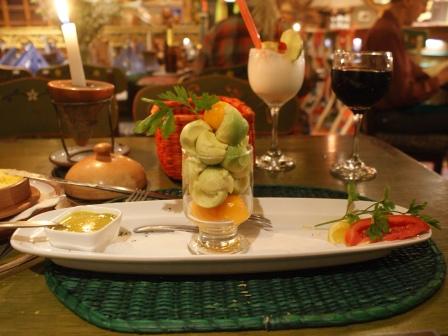
But if you want an interior inspired by Gauguin, Leonard Cohen as background music and Abbot Ale from Suffolk on tap go to Indio Feliz in Aguas Calientes (the town that serves Machu Picchu) where there’s a french chef and good reputation. very good. Go there.
The service is super and supported by a system which links front of house with the kitchen. I started with avocado and mango and then enjoyed a quite excellent truite a la meuniere. The pisco sour started me off well and I continued with a glass of Chilean Cabernet Sauvignon.
There are other good restaurants in Peru, both Lonely Planet and TripAdvisor give good advice. Check out el Piloto on the Panamerican Highway at km 138 south of Lima, Chicha and Zig Zag in Arequipa and Marcela Batata, Uchu and A Mi Manera in Cusco.
And finally: there’s always something in a country’s cuisine that perhaps should be avoided. In Peru it’s pacha manga: potatoes and corns (Peru has lots of different kinds of potatoes and corns), meat and fish baked underground. One of my travellers asked how they could ensure that beef, pork and chicken could all be cooked properly if they were all subject to the same process. Easy. They were all cooked to the level of shoe leather.


 David Jenkins' weblog
Leave a comment